
Applications / AI Data Centers
Static transfer switches for AI data centers
AI halls concentrate more power, more cooling and more capital per rack than any data center before them. TwinSource static transfer switches cover that hall from the busway down: above the TPU racks, in the network racks, and on the walls beside the CDUs and controls, each moving its load to a healthy source as fast as a quarter cycle.
Density raised the cost of every interruption
Racks that once drew 10 kW now draw 100 kW and more, and they depend on liquid loops run by pumps, valves and controllers. Training jobs span thousands of accelerators at once, so a fault that drops one row can stall the whole job until it restarts from its last checkpoint. The power train has grown to match, yet the weak points are the ones they have always been: a distribution breaker, a feeder, a panel, or a technician working on the wrong one.
Racks with two inputs ride through one of those events, until both inputs share the fault, or one is out for maintenance when the other is lost. Around them sits a long list of equipment with a single input: network spines, storage heads, management switches, coolant distribution units, leak detection and rack controllers. Each is a place where a redundant design quietly loses a level.
What to protect
From the busway to the walls
Above the TPU racks, each rack input comes from its own static transfer switch, mounted between the busway and the rack. Each switch takes two of the hall’s busways, and the pairs rotate (A and B, B and C, C and A), so losing any one busway, tap-off or breaker leaves every rack input live.
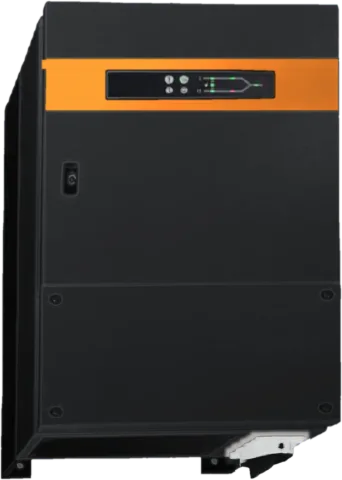
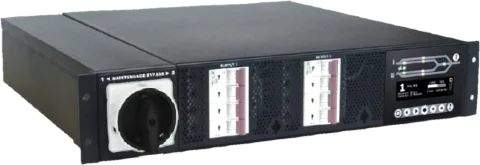
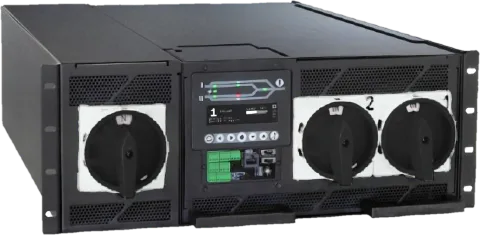
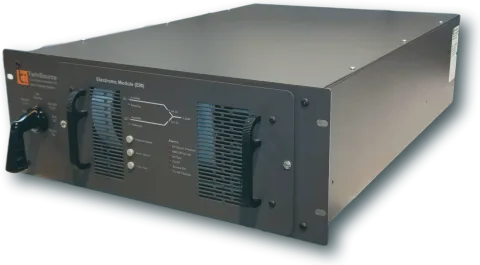
In the network racks, a rack-mount switch gives single-input spine, management and storage switches a second source. On the walls, wall-mount switches feed the CDUs and the controls for cooling, leak detection and the building from two busways or panels.
Every switch monitors both sources continuously and, when the preferred source leaves tolerance, moves the load to the other as fast as a quarter cycle per phase, 4.2 ms at 60 Hz. Power supplies built to the ITIC curve ride through 20 ms, so the load never registers the event. At the point of use, the switch also covers everything upstream of it: the tap-off, the breaker, the panel and the whip.
Why a quarter cycle matters
Power supplies built to the ITIC curve keep running through 20 ms with no input at all. A transfer that finishes well inside that window is invisible to the load.
Why TwinSource
- Three-phase DCC-4 models in 3-pole and 4-pole, 200/115 V to 480/277 V, for halls built on 415 V or 480 V distribution
- Transfers as fast as ¼ cycle per phase using SCRs, break-before-make
- 100% continuous-duty ratings: a 50 A switch carries 50 A all day
- Built-in bypass isolation or maintenance bypass, so the electronics can be serviced without dropping the load
- 2-pole and 4-pole models switch the neutral, which keeps separately derived sources separate
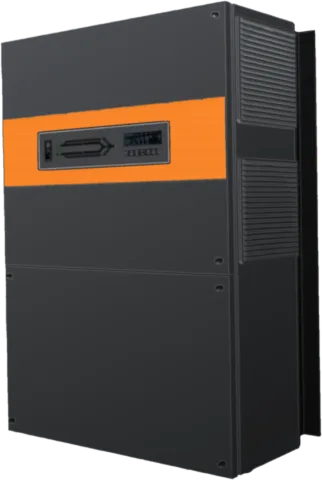
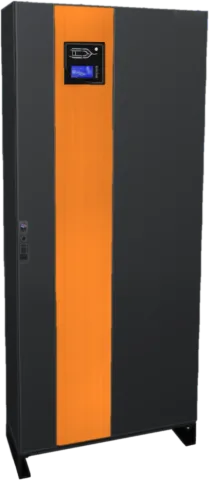
- Rack, wall and free-standing enclosures from 10 A to 600 A, 100 V to 480 V, 50 or 60 Hz
In service
TwinSource switches are installed in AI data centers, protecting the single-corded network, storage and cooling control loads that sit alongside dual-corded compute.
Recommended families
Questions engineers ask
Why put a switch on a rack that already has two inputs?
Two inputs protect a rack against one failure. When each input comes through its own switch fed from two busways, the rack keeps both inputs through a busway outage, and still has one if a second fault arrives while something is out for maintenance.
Will a transfer reset my equipment?
No. The transfer completes as fast as a quarter cycle per phase, 4.2 ms at 60 Hz and 5 ms at 50 Hz, and even an out-of-phase transfer finishes within 12 ms. Power supplies designed to the ITIC curve tolerate 20 ms with no input at all.
Can the two sources be out of phase?
Yes. TwinSource switches transfer break-before-make at any phase angle, so the sources are never paralleled. If a transformer sits downstream of the switch, talk to our engineers about inrush during an out-of-phase transfer.
Ready to specify?
Narrow the range to your voltage, current and mounting, or send us the one-line diagram and talk to an engineer.