
Applications / Communications & Controls
Static transfer switches for communications and control systems
Communications sites are judged on one number: availability. TwinSource rack-mount transfer switches give AC-powered routers, radios, consoles and control networks two sources and a transfer fast enough that no session drops.
The network is only as redundant as its power cords
Carrier hubs, network cores, public-safety dispatch centers and industrial control networks are built with redundant paths and redundant equipment. The power feeding that equipment is often less disciplined. Routers, microwave radios, dispatch consoles, logging recorders, distributed antenna head-ends and timing sources frequently ship with a single AC input.
One tripped breaker or one failed inverter then takes down a device that the rest of the architecture assumes is always there. For a site that hosts thousands of users, the result is lost revenue and lost credibility. For a dispatch center or a plant control network, it is lost visibility at the moment it matters.
What to protect
Two AC sources at the equipment rack
A TwinSource switch mounts in the same 19-inch rack as the equipment it protects. It takes two AC feeds, for example an inverter output and a utility or UPS panel, and delivers one output. A loss or sag on the preferred source triggers a transfer as fast as a quarter cycle on the static models, and under half a cycle on the relay-based DCC-I. Links stay up and calls stay connected.
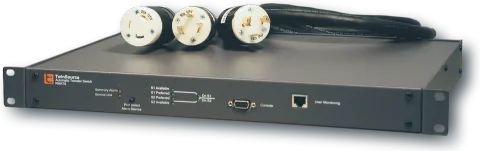
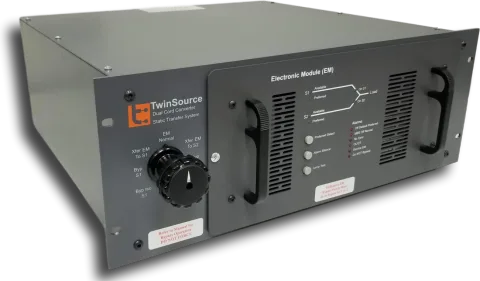
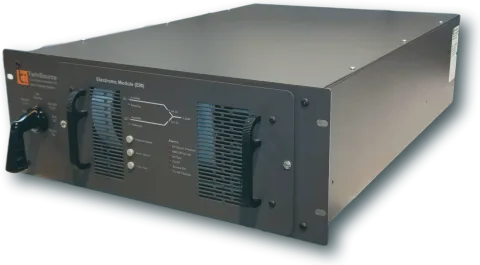
The 1U DCC-I suits shelters and small rooms with loads from 12 to 24 A and comes with NEMA locking or IEC connectors. The DCC-II carries 30 to 50 A for full equipment racks. Both are 2-pole, so they are safe between separately derived sources, and both report status through remote contacts that a network management system can watch.
Why a quarter cycle matters
Power supplies built to the ITIC curve keep running through 20 ms with no input at all. A transfer that finishes well inside that window is invisible to the load.
Why TwinSource
- 1U DCC-I with NEMA L5, L6, C13 or C19 connections for plug-and-play installation
- Transfers as fast as ¼ cycle per phase using SCRs, break-before-make
- 100% continuous-duty ratings: a 50 A switch carries 50 A all day
- Built-in bypass isolation or maintenance bypass, so the electronics can be serviced without dropping the load
- 2-pole and 4-pole models switch the neutral, which keeps separately derived sources separate
- Rack, wall and free-standing enclosures from 10 A to 600 A, 100 V to 480 V, 50 or 60 Hz
In service
TwinSource switches are in service at telecommunications sites that host large numbers of users and cannot go down without losing revenue and standing with their customers.
Recommended families
Questions engineers ask
We run a 48 V DC plant. Where does an AC transfer switch fit?
The DC plant covers DC-powered equipment. Servers, consoles, recorders and many radios are AC only and run from inverters or a UPS. The STS gives that AC equipment a second source, such as the inverter on one side and a utility panel on the other.
Can we monitor the switch remotely?
Yes. Remote contacts report source availability, which source is carrying the load, and summary alarms. The DCC-II and DCC-III add RS-485.
What about 230 V, 50 Hz sites?
TwinSource switches are built for 100 V through 240 V single-phase at 50 or 60 Hz, so the same product family serves sites worldwide.
Ready to specify?
Narrow the range to your voltage, current and mounting, or send us the one-line diagram and talk to an engineer.