
Applications / Renewable / Wind Farm / Utility Controls
Static transfer switches for wind, solar and storage plant controls
A renewable plant earns only while its control system is awake. TwinSource static transfer switches keep the plant controller, SCADA and grid telemetry running at remote, unmanned sites where a locked-up server means a truck roll.
Small control loads carry the whole plant
A wind, solar or storage plant may produce hundreds of megawatts, and it is dispatched through a few kilowatts of electronics in the collector substation control house: the power plant controller, SCADA servers, meteorological data systems, protection communications and the telemetry link to the grid operator. If that equipment drops, the plant can be curtailed or tripped offline even though every turbine and inverter is healthy.
Auxiliary power at these sites comes from a station service transformer, with a second feeder, a generator or a battery inverter as backup. The transfer between them is often mechanical and slow enough to reboot computer-based equipment. At an unmanned site, a controller that does not come back cleanly waits for a technician to arrive.
What to protect
Ride through at the control house
A TwinSource STS between the two auxiliary sources feeds the control loads and transfers as fast as a quarter cycle, so nothing restarts. Because the transfer is break-before-make, the two sources are never paralleled, which suits inverter-based backup sources. Alarm contacts and RS-485 report the transfer into plant SCADA, so the operations center knows about it without anyone on site.
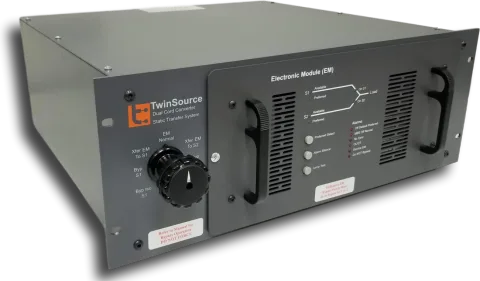
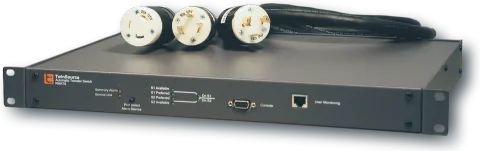
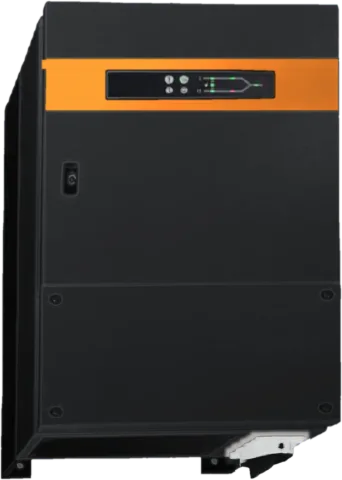
The DCC-II fits control house racks at 30 to 50 A single-phase. The 1U DCC-I serves small telemetry and met station cabinets. The wall-mount DCC-4-W covers three-phase auxiliary panels, including battery storage thermal management controls. With ratings from 100 V to 480 V at 50 or 60 Hz, one product family covers a global fleet.
Why a quarter cycle matters
Power supplies built to the ITIC curve keep running through 20 ms with no input at all. A transfer that finishes well inside that window is invisible to the load.
Why TwinSource
- Remote status reporting built for unmanned sites
- Transfers as fast as ¼ cycle per phase using SCRs, break-before-make
- 100% continuous-duty ratings: a 50 A switch carries 50 A all day
- Built-in bypass isolation or maintenance bypass, so the electronics can be serviced without dropping the load
- 2-pole and 4-pole models switch the neutral, which keeps separately derived sources separate
- Rack, wall and free-standing enclosures from 10 A to 600 A, 100 V to 480 V, 50 or 60 Hz
In service
TwinSource switches are in service at wind farms and utility-scale renewable sites, keeping plant controls and grid telemetry powered.
Recommended families
Questions engineers ask
Sites are unmanned. How do we know the switch transferred?
Alarm contacts indicate source availability, the source in use and summary alarms, and they wire into the site RTU as ordinary points. The DCC-II and DCC-III add RS-485.
Does it work with an inverter as one source?
Yes. The switch transfers between any two AC sources inside its voltage and frequency window and never parallels them. Confirm that the inverter can accept the full load as a step.
Do the turbines themselves need one?
Turbine pitch and control systems carry their own backup. The STS belongs at the plant level, in the control house and substation, where a single controller speaks for the entire site.
Ready to specify?
Narrow the range to your voltage, current and mounting, or send us the one-line diagram and talk to an engineer.