
Applications / Air Traffic Control Applications
Static transfer switches for air traffic control facilities
In an air traffic control facility, losing power to computers and displays puts passenger safety at risk and ripples into delays across the system. TwinSource static transfer switches keep that equipment on a live source, position by position.
Critical power still has to reach the console
Air traffic facilities are among the best-protected electrical environments anywhere. En-route centers run dedicated critical and essential power systems built from UPS modules, static switches, engine generators and critical power centers. Static transfer switches have long been standard at air traffic control sites for exactly this reason.
Yet the last stretch is the most exposed. Between the critical bus and the equipment sit panels, breakers, feeders and people. Controller displays, voice switching, recorders, radar and flight data processors, and network equipment often have a single power input. A failure downstream of the central system takes them down no matter how robust the plant behind it is.
What to protect
Both critical buses, at the equipment rack
A TwinSource rack-mount STS takes a feed from each of two independent critical sources and delivers one output to single-corded equipment. If the preferred feed is lost, the load moves to the other as fast as a quarter cycle, inside the ride-through of the equipment's own power supplies. Displays stay lit and voice channels stay up.
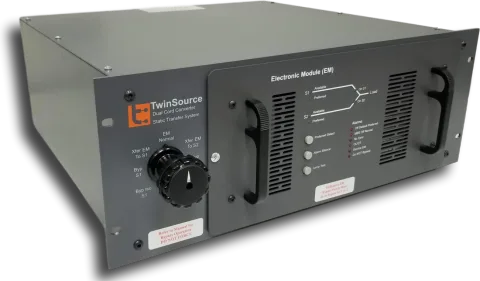
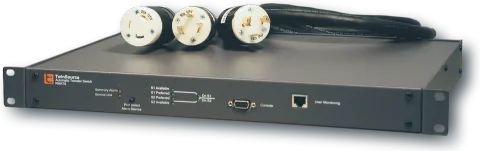
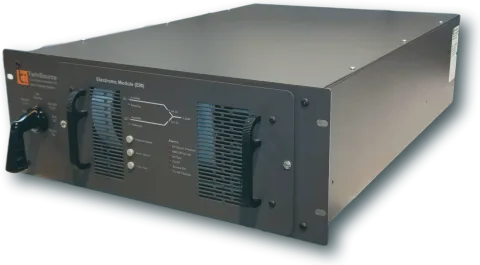
The DCC-II carries 30 to 50 A in a 4U chassis. Its electronic module, which holds the logic and the SCRs, withdraws completely for service while the built-in bypass carries the load, so maintenance never takes a position out. Remote contacts report status to facility monitoring. For towers, radar sites and navigation aids with smaller loads, the 1U DCC-I handles 12 to 24 A. All models operate at 50 or 60 Hz across 100 V to 240 V, for facilities anywhere in the world.
Why a quarter cycle matters
Power supplies built to the ITIC curve keep running through 20 ms with no input at all. A transfer that finishes well inside that window is invisible to the load.
Why TwinSource
- Fully withdrawable electronic module with bypass on the outer enclosure
- Transfers as fast as ¼ cycle per phase using SCRs, break-before-make
- 100% continuous-duty ratings: a 50 A switch carries 50 A all day
- Built-in bypass isolation or maintenance bypass, so the electronics can be serviced without dropping the load
- 2-pole and 4-pole models switch the neutral, which keeps separately derived sources separate
- Rack, wall and free-standing enclosures from 10 A to 600 A, 100 V to 480 V, 50 or 60 Hz
In service
TwinSource switches are in service in air traffic control centers, where loss of power to computers and display systems poses a risk to passenger safety and causes flight delays.
Recommended families
Questions engineers ask
The facility already has a central critical power system. Why add rack-level switches?
Because the central system cannot see failures downstream of itself. A point-of-use switch covers the panel, breaker, feeder and human error between the critical bus and the equipment.
Are towers and remote sites too small to justify it?
The 1U DCC-I is built for small loads, 12 to 24 A, and installs with plug connections. It gives a remote site two sources for little space and cost.
Can the switch be serviced without taking a position down?
Yes. The bypass carries the load while the electronic module is withdrawn, and interlocks guard the sequence.
Ready to specify?
Narrow the range to your voltage, current and mounting, or send us the one-line diagram and talk to an engineer.