
Applications / TPU/GPU Clusters
Static transfer switches for TPU/GPU clusters
A TPU/GPU cluster behaves like one machine. Thousands of accelerators move in lockstep over a fabric, and the job is only as available as its least-protected switch, controller or pump. TwinSource static transfer switches close those gaps at the rack.
One dropped device can stall the whole job
Synchronous training ties every GPU to every other GPU. When a leaf switch, a management node or a rack controller loses power, the collective operation hangs, the scheduler ends the job, and the cluster rolls back to its last checkpoint. The hardware may be back in seconds. The lost work is counted in GPU-hours across the entire allocation.
Most GPU servers and power shelves accept two feeds and tolerate the loss of one. The exposure is in what does not: management and out-of-band switches, timing sources, storage gateways, login and scheduler nodes, in-rack coolant distribution units, and the leak and power controllers bolted into the rack. They are small loads, and they are easy to overlook on a one-line diagram.
What to protect
Two sources for every single input
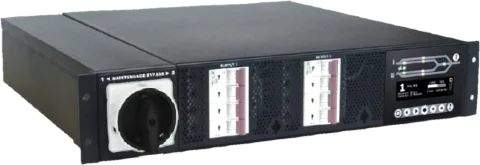
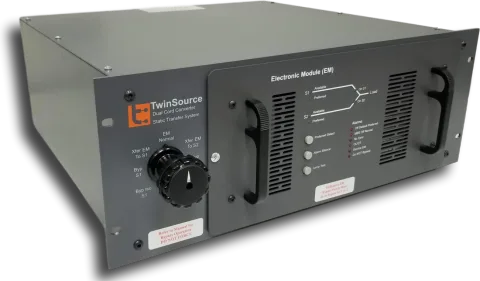
A rack-mount TwinSource STS takes the A and B feeds already present at the rack and delivers one protected output. If the preferred feed sags or disappears, the switch moves the load to the other feed as fast as a quarter cycle, well inside the 20 ms that IT power supplies ride through. Nothing reboots, no link flaps, and the job keeps running.
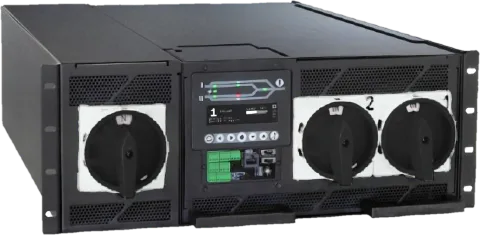
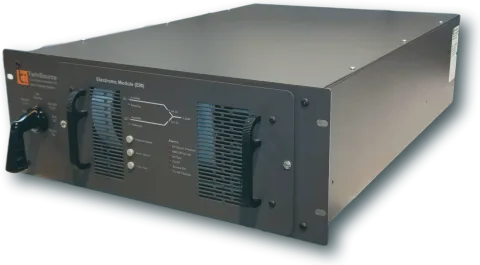
GPU rows are fed three-phase, commonly 415/240 V or 208/120 V. The DCC-4-R covers both in 3-pole and 4-pole builds up to 60 A, and the DCC-4-R4 extends that to 120 A. For single-phase management gear, the DCC-II carries 30 to 50 A in 4U with a plug-in electronic module.
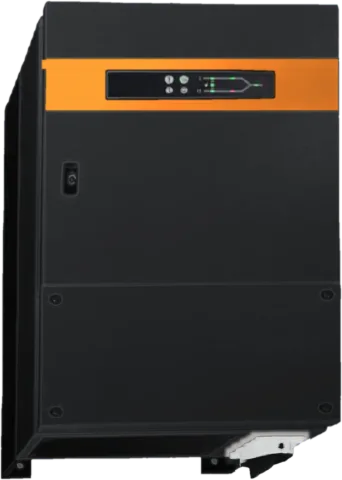
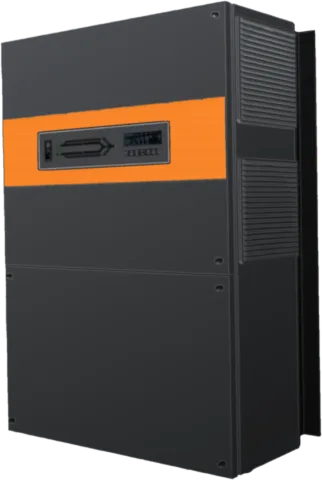
Where the racks are fed from overhead busway, the switch can also hang above the row: a wall-mount DCC-4-W or DCC-4-W4 takes two busways and feeds one or two racks below it, leaving the rack space for compute.
Why a quarter cycle matters
Power supplies built to the ITIC curve keep running through 20 ms with no input at all. A transfer that finishes well inside that window is invisible to the load.
Why TwinSource
- Rack-mount DCC-4-R and DCC-4-R4 are hot-swappable with maintenance bypass, so service does not mean a job restart
- Transfers as fast as ¼ cycle per phase using SCRs, break-before-make
- 100% continuous-duty ratings: a 50 A switch carries 50 A all day
- Built-in bypass isolation or maintenance bypass, so the electronics can be serviced without dropping the load
- 2-pole and 4-pole models switch the neutral, which keeps separately derived sources separate
- Rack, wall and free-standing enclosures from 10 A to 600 A, 100 V to 480 V, 50 or 60 Hz
In service
TwinSource rack-mount switches are in service in TPU/GPU cluster deployments, feeding the fabric, management and cooling equipment that has only one power input.
Recommended families
Questions engineers ask
Can one STS feed an entire GPU rack?
It can. A 100 kW rack at 415 V draws about 140 A, which lands on a 150 A DCC-4-S. Most sites get more value from protecting the single-corded equipment, which needs far smaller switches.
What size switch do auxiliary loads need?
Match the rating to the branch circuit feeding the load. TwinSource ratings are 100% continuous duty, so a 30 A switch carries 30 A without derating. The configurator narrows the choice in a few clicks.
Does the transfer disturb the network fabric?
No. The load sees a gap as short as a quarter cycle, well inside what its power supply bridges from stored energy. Ports stay up and sessions stay established.
Ready to specify?
Narrow the range to your voltage, current and mounting, or send us the one-line diagram and talk to an engineer.