
Applications / Nuclear Power Applications
Static transfer switches for nuclear power plant support systems
A nuclear site runs hundreds of non-safety electronic systems where a power blink means lost data, lost visibility and a condition report. TwinSource static transfer switches give those systems a second source and a transfer they never feel.
Availability matters on the non-safety side too
Safety-related power is designed, qualified and maintained to its own standards, and this page is not about it. Around it sits a large population of commercial-grade electronics that the plant depends on every day: the plant process computer, security and access systems, radiation monitoring displays, meteorological data systems, the emergency response facilities, training simulators and balance-of-plant controls.
These systems are typically AC powered with a single input, and they restart slowly. A dropped plant computer takes trending and alarm history with it. A security system that reboots triggers compensatory measures. A balance-of-plant control fault can lead to a runback or a trip, and every day offline is a day of lost generation.
What to protect
A familiar concept, applied at the load
Plant engineers already know the principle. Instrument buses are commonly fed by inverters with a static transfer to a backup regulated source. A TwinSource STS applies the same idea at the point of use: two non-safety AC sources in, one protected output, and a transfer as fast as a quarter cycle. The 2-pole design switches both conductors so the sources stay independent.
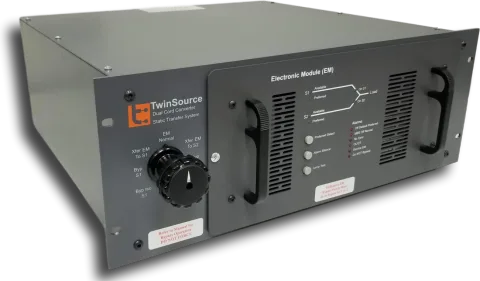
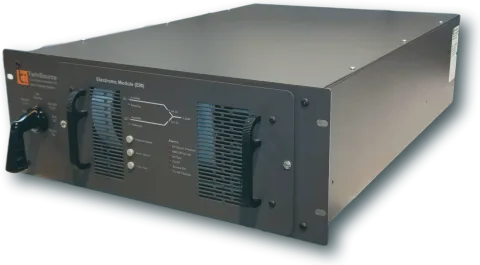
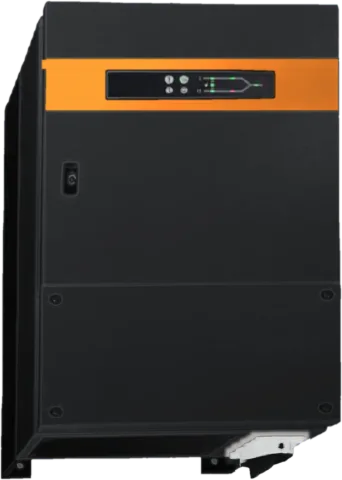
The DCC-II provides 30 to 50 A single-phase in a 4U rack chassis, with built-in bypass isolation so the electronic module can be withdrawn without de-energizing the load. The DCC-III and DCC-4 families extend that to three-phase systems. Alarm contacts bring switch status to the control room or the plant computer.
Why a quarter cycle matters
Power supplies built to the ITIC curve keep running through 20 ms with no input at all. A transfer that finishes well inside that window is invisible to the load.
Why TwinSource
- Bypass isolation with interlocks, so maintenance never requires a load outage
- Transfers as fast as ¼ cycle per phase using SCRs, break-before-make
- 100% continuous-duty ratings: a 50 A switch carries 50 A all day
- Built-in bypass isolation or maintenance bypass, so the electronics can be serviced without dropping the load
- 2-pole and 4-pole models switch the neutral, which keeps separately derived sources separate
- Rack, wall and free-standing enclosures from 10 A to 600 A, 100 V to 480 V, 50 or 60 Hz
In service
TwinSource switches are installed at nuclear power plants, where they protect plant support systems that operators rely on every shift.
Recommended families
Questions engineers ask
Can a TwinSource STS be used in a Class 1E system?
TwinSource switches are commercial-grade products intended for non-safety applications. Safety-related use brings qualification and dedication requirements outside the scope of this page. Talk to our engineers before specifying one.
Which loads see the most benefit?
Computer-based systems with long restart times and a single power input: the plant computer, security servers, monitoring displays and digital balance-of-plant controllers.
Can the switch be maintained at power?
Yes. The bypass carries the load while the electronic module is removed, and interlocks prevent an incorrect bypass sequence.
Ready to specify?
Narrow the range to your voltage, current and mounting, or send us the one-line diagram and talk to an engineer.