
Applications / Traditional Data Centers
Static transfer switches for enterprise and colocation data centers
Two independent UPS systems only protect equipment that can reach both of them. TwinSource rack-mount static transfer switches bring both sides of a 2N design to single-corded loads, at the rack, where the failures actually happen.
Most outages start between the UPS and the load
The 2N data center exists because single large UPS systems failed too often. The failures that remain are rarely the UPS itself. Many UPS power failures trace to human error during maintenance or operation, and the rest of the risk sits in ordinary hardware: distribution panels, breakers, feeders and power strips.
None of that is covered by a large STS in the switchgear room, because the problem occurs downstream of it. And when a large switch does fail, 20 or 30 racks feel it at once. A rack-mount switch limits the exposure to one rack: losing 30 A of load is always less disruptive than losing 600 A.
What to protect
Point-of-use protection, one rack at a time
A TwinSource rack-mount STS takes the A and B feeds that already arrive at every rack and gives single-corded equipment one protected output. Transfers complete as fast as a quarter cycle. No special conduit runs are needed, and the switch moves with the equipment when the floor plan changes.
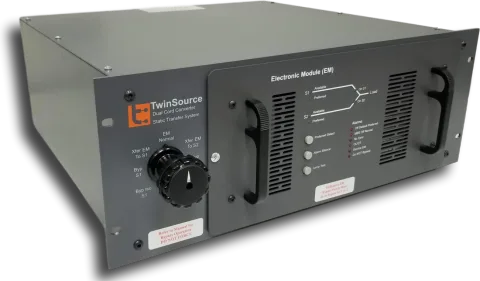
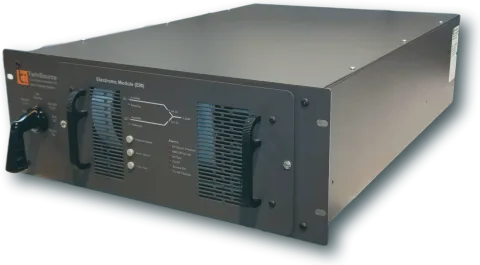
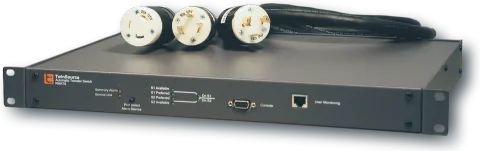
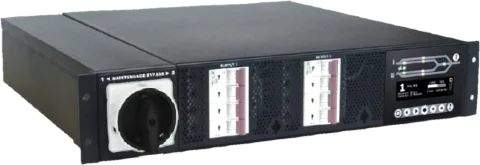
The DCC-II is the workhorse: 2-pole, 30 to 50 A, with a plug-in electronic module that withdraws for service while the built-in bypass carries the load. The DCC-III adds a fourth pole for 208/120 V three-phase racks up to 18 kW. For less critical single-phase loads, the 1U DCC-I uses MagLatch relays and transfers in under half a cycle. Static switches also double as a maintenance tool, moving load off a bus so it can be worked on safely.
Why a quarter cycle matters
Power supplies built to the ITIC curve keep running through 20 ms with no input at all. A transfer that finishes well inside that window is invisible to the load.
Why TwinSource
- Remote alarm contacts and RS-485 on the DCC-II and DCC-III for DCIM integration
- Transfers as fast as ¼ cycle per phase using SCRs, break-before-make
- 100% continuous-duty ratings: a 50 A switch carries 50 A all day
- Built-in bypass isolation or maintenance bypass, so the electronics can be serviced without dropping the load
- 2-pole and 4-pole models switch the neutral, which keeps separately derived sources separate
- Rack, wall and free-standing enclosures from 10 A to 600 A, 100 V to 480 V, 50 or 60 Hz
In service
TwinSource rack-mount switches are in service in enterprise data centers, financial operations centers and telecommunications sites that run around the clock, where an outage means lost revenue and lost credibility.
Recommended families
Questions engineers ask
Static switch or relay-based ATS?
Both finish well inside the 20 ms that IT power supplies tolerate. The SCR-based DCC-II and DCC-III transfer as fast as a quarter cycle and add bypass isolation and richer monitoring. The relay-based DCC-I transfers in under half a cycle and suits less critical loads up to 24 A.
Why does the switch need two poles?
A transfer should look like unplugging the load from one outlet and plugging it into a completely independent one. Switching both conductors, neutral included, keeps separately derived UPS systems from sharing a neutral, which would create a second ground path and a code violation.
Is it cheaper to duplicate the servers instead?
Rarely. A second set of servers doubles hardware, power and heat, and a bad power supply in one can still leave you exposed. Many sites run redundant servers and feed each rack through its own STS.
Ready to specify?
Narrow the range to your voltage, current and mounting, or send us the one-line diagram and talk to an engineer.