
Applications / Cooling Distribution Units (CDUs)
Static transfer switches for coolant distribution units
In a liquid-cooled hall the CDU is as critical as the UPS. If its pumps stop, the racks it serves have seconds of thermal margin, where air-cooled rooms had minutes. A TwinSource STS keeps the CDU on whichever source is healthy.
Cold plates leave almost no thermal mass
Direct-to-chip cooling pulls heat from the processor through a small volume of moving coolant. When secondary flow stops, chip temperatures climb quickly. Servers throttle first and then shut themselves down to protect the silicon. One in-row CDU can serve a megawatt or more of IT load, so a single power event at the CDU can take out a row that never lost power itself.
CDU manufacturers know this, and many units ship with dual power feeds and an internal automatic transfer switch. That helps, but it is worth asking what happens during the transfer. A contactor-based switch can open long enough to drop the pump drives and the controller into a restart sequence, and flow is interrupted while they recover. Other CDUs, and much of the facility-side equipment that supports them, have a single input and no second source at all.
What to protect
Keep the drives running through the event
A TwinSource STS ahead of the CDU input selects between two independent sources and transfers as fast as a quarter cycle. Variable-speed drives and PLCs ride through a gap that short on their own stored energy, so pumps hold speed and the control loop never restarts.
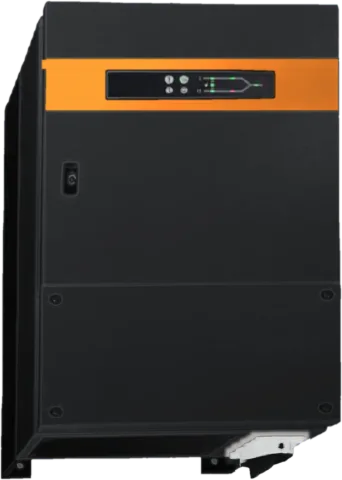
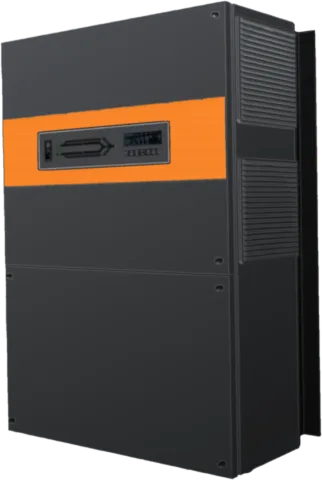
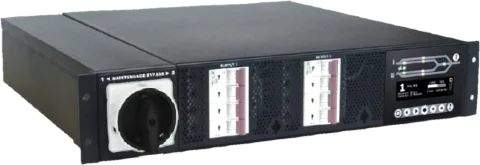
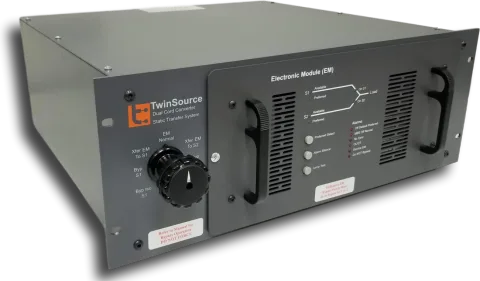
The wall-mount DCC-4-W and DCC-4-W4 sit beside in-row and gallery CDUs on three-phase 480 V, 415 V or 208 V circuits from 10 to 120 A. The DCC-4-R serves in-rack CDUs. For single-phase controllers, sensors and leak detection, the DCC-II provides 30 to 50 A in a 4U chassis. Size the switch to the full-load current of the CDU circuit; ratings are 100% continuous duty.
Why a quarter cycle matters
Power supplies built to the ITIC curve keep running through 20 ms with no input at all. A transfer that finishes well inside that window is invisible to the load.
Why TwinSource
- Wall-mount enclosures for mechanical galleries where there is no rack space
- Transfers as fast as ¼ cycle per phase using SCRs, break-before-make
- 100% continuous-duty ratings: a 50 A switch carries 50 A all day
- Built-in bypass isolation or maintenance bypass, so the electronics can be serviced without dropping the load
- 2-pole and 4-pole models switch the neutral, which keeps separately derived sources separate
- Rack, wall and free-standing enclosures from 10 A to 600 A, 100 V to 480 V, 50 or 60 Hz
In service
TwinSource switches are installed ahead of coolant distribution units in liquid-cooled halls, keeping pumps and controls on a live source.
Recommended families
Questions engineers ask
My CDU already has dual feeds and an ATS. Do I still need an STS?
Check two things: the transfer time of the internal switch, and whether the pump drives and controller stay running through it. If either restarts, coolant flow is interrupted. A static switch that transfers as fast as a quarter cycle avoids the restart.
Should CDUs be on UPS power?
That is a design decision for the facility. Because thermal margin is so short, many operators put pumps on UPS or on a dedicated mechanical UPS. An STS works between two UPS outputs, or between a UPS and a generator-backed bus.
Can the STS handle pump motor loads?
Yes, within its current rating. For large motors or transformer-fed loads, our engineers will review inrush during transfer with you before you order.
Ready to specify?
Narrow the range to your voltage, current and mounting, or send us the one-line diagram and talk to an engineer.