
Applications / BMS / Surveillance Controls
Static transfer switches for BMS, security and surveillance systems
A building management system or a security head-end does its most important work during an abnormal event. TwinSource transfer switches make sure a power problem is never the reason it goes quiet.
The facility goes blind exactly when you need to see
BMS servers and network controllers, access control panels, video recorders, camera network switches and intercom systems are nearly all single-corded. Many are protected only by a small local UPS that nobody has tested since it was installed. When that UPS fails, or the panel behind it trips, the operator loses alarms and trends, doors fall back to their default state, and the video record has a hole in it.
For a data center, a hospital, a laboratory or a secure site, those gaps are more than an inconvenience. Missing video and unlogged door events become audit findings. Missing temperature and leak alarms become equipment damage.
What to protect
A second source for small, important loads
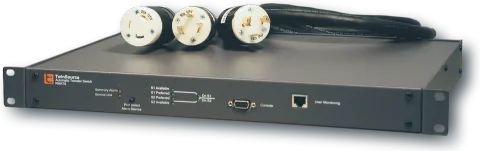
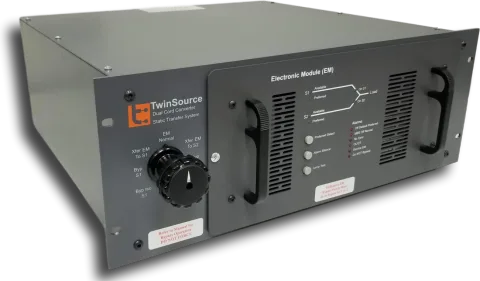
These are modest loads, which makes them inexpensive to protect properly. The 1U DCC-I carries 12 to 24 A and transfers between two sources in under half a cycle using MagLatch latching relays. A PoE switch fed through it never drops its ports, so cameras and controllers do not reboot. For a full security or BMS head-end rack, the SCR-based DCC-II carries 30 to 50 A and transfers as fast as a quarter cycle, with a bypass that lets the electronics be serviced under load.
A common arrangement uses the existing UPS as the preferred source and a generator-backed panel as the alternate. The load is then covered for a utility outage, a UPS failure and UPS maintenance.
Why a quarter cycle matters
Power supplies built to the ITIC curve keep running through 20 ms with no input at all. A transfer that finishes well inside that window is invisible to the load.
Why TwinSource
- Compact 1U DCC-I for security closets and control cabinets with limited space
- Transfers as fast as ¼ cycle per phase using SCRs, break-before-make
- 100% continuous-duty ratings: a 50 A switch carries 50 A all day
- Built-in bypass isolation or maintenance bypass, so the electronics can be serviced without dropping the load
- 2-pole and 4-pole models switch the neutral, which keeps separately derived sources separate
- Rack, wall and free-standing enclosures from 10 A to 600 A, 100 V to 480 V, 50 or 60 Hz
In service
TwinSource switches are in service on building management, security and surveillance systems at critical facilities.
Recommended families
Questions engineers ask
Is a small UPS not enough?
A UPS carries the load through an outage until its battery runs down. It cannot help when the UPS itself fails or is being replaced. Put an STS after it with a second source and both cases are covered.
Will PoE cameras stay up during a transfer?
Yes, as long as the PoE switch stays powered. The transfer is shorter than the hold-up time of the switch's power supply, so ports stay energized and cameras do not reboot.
Does this apply to fire alarm systems?
Fire alarm and life-safety systems have their own code-required power arrangements. A transfer switch does not replace them. It is intended for the building management, security and monitoring systems around them.
Ready to specify?
Narrow the range to your voltage, current and mounting, or send us the one-line diagram and talk to an engineer.