
Products / ATS
Rack-mount automatic transfer switches
Some loads need two sources without needing a static switch. The DCC-I is a 1U, relay-based automatic transfer switch for single-phase loads up to 24 A. Its patented MagLatch relays remove the failure modes that give rack ATS units a bad name.
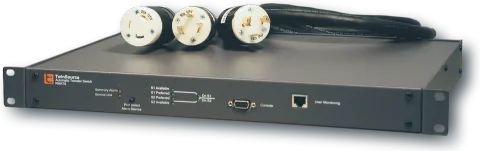
single phase, 100–240 V
transfer, in phase or out of phase
with NEMA locking or IEC connections
What MagLatch changes
A conventional spring-return relay holds one position with a spring and the other with a coil that must stay energized. Try both designs: transfer the load, then take away control power.
Built for the rack
The DCC-I takes two single-phase feeds and supplies one output, in 1U. When the preferred source leaves its window, the load moves to the alternate in under half a cycle, inside the 20 ms that IT power supplies ride through, whether the sources are in phase or not. It comes with NEMA L5 or L6 locking connectors from 15 to 30 A, or IEC C13 and C19 outlet groups, so it installs with plugs.
Remote contacts report status and alarms, RS-485 is available, and the unit captures the waveform of the last transfer for diagnostics. It is TÜV certified to UL/IEC 60950.
ATS or STS?
Use a relay ATS where the load is under 24 A, servers are redundant and an occasional unit replacement is acceptable. Use a static switch where the load must never drop, where current is higher, or where you need to service the switch without an outage. Set your load's ride-through below to see where each technology stands.
Not a generator transfer switch
The large ATS in the electrical room moves a building between utility and generator, and takes 20 to 45 seconds doing it. A rack-mount ATS does a different job: it gives one rack two live sources and a transfer the equipment does not feel.
What to check on any rack ATS
- The switching element. Few relay products say "relay" on the datasheet, and some use the letters STS for a relay design.
- The rating at your power factor. Relay ratings are often quoted for resistive loads and can fall by half at 0.85.
- Transfer time with the sources out of phase, not only in phase. Some designs add a long delay, and some will not transfer beyond 15 to 20 degrees.
- Whether any coil stays energized in normal operation, and what that does to relay life.
- The nameplate fault rating, and where the fault protection is.
Models in this category
Where they are used
Go deeper
Questions engineers ask
What is the difference between an ATS and an STS?
The switching element. An ATS uses moving contacts, an STS uses SCRs. That drives transfer time, service life, current capacity and whether the unit can be bypassed for maintenance.
Will the DCC-I transfer between unsynchronized sources?
Yes, in under half a cycle, in phase or out of phase.
What happens if the DCC-I loses control power?
The MagLatch relays stay where they are. There is no spring to pull the contacts back and no coil that has to stay energized.
Ready to specify?
Open the configurator with this category already selected, or send us your one-line diagram.